Researchers at Anthropic have developed a new measure called observed exposure to track which jobs are actually being affected by AI in real-world settings, finding that whilst AI has significant potential to automate tasks, actual usage remains far below theoretical capability, and early evidence shows limited impact on unemployment but some signs of slowed hiring for younger workers.
Key Points
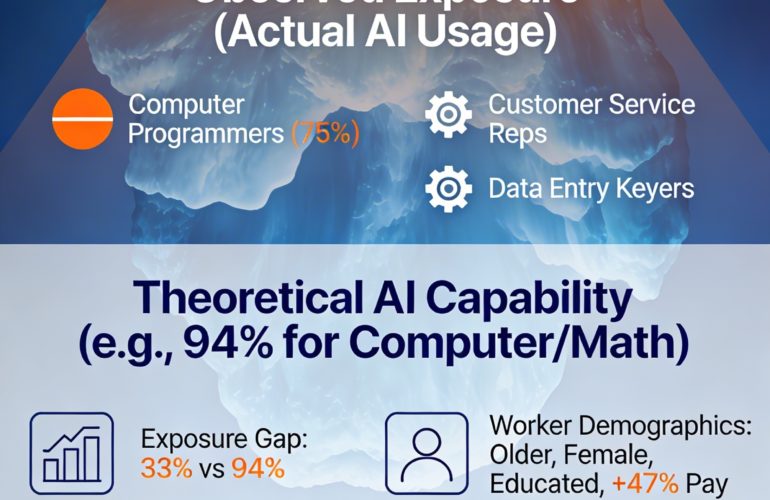
Observed exposure combines theoretical AI capability with real-world usage data, revealing that actual AI coverage is only a fraction of what is theoretically possible (for example, AI covers just 33% of Computer and Math tasks despite being theoretically capable of 94%)
Computer Programmers face the highest exposure at 75% coverage, followed by Customer Service Representatives and Data Entry Keyers, while jobs involving physical work or face-to-face interaction show minimal exposure
Workers in highly exposed occupations tend to be older, female, more educated, and earn 47% more on average than those in unexposed roles, suggesting the impacts will be concentrated among specific worker groups
No meaningful increase in unemployment has occurred for highly exposed workers since late 2022, though there is tentative evidence that hiring of young workers aged 22-25 into exposed occupations has slowed by approximately 14%
The framework allows researchers to track AI impacts as they emerge rather than waiting for large disruptions to become visible, making it useful for identifying vulnerable jobs before displacement becomes widespread
Why It Matters
This research is significant for risk management because it provides an early warning system to identify which occupations and worker groups may face labour market disruption before widespread displacement occurs. The finding that younger workers are experiencing reduced hiring into AI-exposed roles suggests emerging labour market friction that could intensify as AI capabilities advance. The concentration of exposure among higher-paid, educated workers indicates that whilst some groups face disruption, others may be partially shielded. However, the gap between theoretical capability (what AI could theoretically do) and observed usage (what AI is actually doing) highlights substantial uncertainty: many tasks could theoretically be automated but have not yet been, creating both risk and opportunity depending on adoption speed. Risk managers should note that historical precedent suggests such labour market disruptions often play out over years rather than creating sudden shocks, making early intervention more feasible than crisis response. The framework’s ability to update regularly as new data emerges means early indicators of acceleration or deceleration in AI’s labour market impact should be monitored closely. The demographic skew towards female and highly educated workers in exposed roles may create specific policy and workforce planning challenges for organisations.
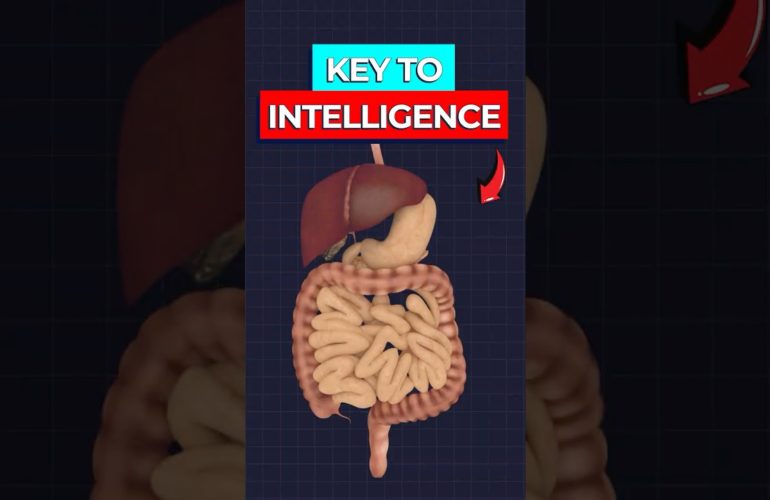
Pioneering research reveals gut bacteria’s profound influence on brain development and potential intelligence.
Key Points
Scientists successfully transplanted gut microbiota from humans and primates into germ-free mice
Microbes demonstrated ability to modify brain gene expression related to energy metabolism
Discovery suggests a metabolic connection between gut bacteria and neural evolution
Why It Matters
This breakthrough could revolutionise understanding of neurodevelopmental mechanisms, offering potential insights into cognitive disorders, brain health trajectories, and novel diagnostic approaches for neurological conditions.
Driverless cabs have moved from the test lab to everyday urban life. They are already operating commercially in several cities around the world, in some cases without safety drivers. Switzerland is also preparing to get started. A look at international experience shows what is possible and where the limits still lie.
In the USA, the West is considered a pioneer. Driverless cabs have been in everyday use in Phoenix for years, and are now also in operation in parts of the San Francisco Bay Area, Los Angeles, Phoenix, Austin and Atlanta. The operator isWaymo, a subsidiary of Alphabet. The vehicles operate without safety drivers, rides are booked via app and are part of regular traffic. Las Vegas is also one of the early deployment locations:Zoox, an Amazon company, is testing autonomous vehicles in a clearly demarcated area on the Strip.
China is the second major arena. Since the launch ofApollo Goin 2020, autonomous cabs have already been driving without a driver in cities with millions of inhabitants, such as Wuhan and Chongqing, as well as 13 other cities. The services are publicly bookable and are actively supported by the local authorities. China is thus deliberately focusing on rapid scaling in urban areas in order to gain experience with autonomous fleets. The fleet and range has been expanded to over 11 million trips for passengers by May 2025 with 1,000 self-driving vehicles.
Further projects exist in Singapore, in individual Japanese cities and in the Middle East, for example in Abu Dhabi. What all these locations have in common is that the vehicles will initially operate in defined zones and their areas of operation will be gradually expanded.
Experiences from everyday life
Experience to date has been ambivalent. Users report smooth, predictable journeys and a high level of compliance with the rules. Especially in heavy city traffic, robotaxis drive more defensively than human drivers. Operators point to millions of autonomously driven kilometers and accident rates that are lower than those of human drivers.
At the same time, everyday life also shows the limits of the technology. Complex traffic situations, roadworks, unclear hand signals and extreme weather conditions remain challenging. In San Francisco, the providerCruise came under pressure after several incidents, including a serious accident involving a pedestrian. This resulted in temporary driving bans and a significant setback in expansion. These events have intensified the regulatory debate worldwide and made it clear that autonomous mobility remains politically sensitive.
Focus on safety and liability
Accidents involving autonomous cabs are rare so far, but they have a high media impact. This is precisely why safety concepts, remote monitoring and clear liability rules are at the center of the discussion. In most markets, it is the operators and not the passengers who are liable. Insurers are keeping a close eye on developments, as risk profiles, loss frequencies and responsibilities are likely to change fundamentally.
And Switzerland?
Driverless transport is also coming closer in this country. Since 2025, the legal framework in Switzerland has permitted the operation of automated vehicles without drivers, provided they are approved by the authorities and operate in clearly defined areas. The first pilot projects are underway, including at theSwiss Transit Lab, where autonomous cabs are being tested in suburban communities.
At the same time, public providers are making preparations.PostBusis planning to use driverless vehicles from 2027, particularly in rural areas, in order to cover the last mile more efficiently. Test drives already started in December 2025, while international providers are looking into entering the market, initially not in large cities but in manageable areas with low traffic density.
A gradual transition
Widely available robotaxis in cities such as Zurich or Basel are not to be expected in the short term. A gradual expansion with pilot zones, limited operating times and close supervision is more likely. International experience shows: A lot is possible in terms of technology, but it will take time in terms of society and regulation.
Changes for the insurance industry
The introduction of driverless cars will fundamentally change the mobility and insurance industry. Falling accident figures are calling traditional risk models and premium structures into question, while new liability issues are affecting manufacturers, software providers and vehicle owners. For Swiss SMEs, this presents both pressure to adapt and opportunities: those who invest early in digital skills, new business models and collaborations will be able to position themselves successfully in a rapidly changing value chain.
Driverless cabs do not arrive abruptly, but quietly, section by section. And this is precisely their greatest challenge.
🚀 Did you know YouTube sees over 1 𝗺𝗶𝗹𝗹𝗶𝗼𝗻 𝗵𝗼𝘂𝗿𝘀 of new content uploaded every single day? Two years ago, we decided to take on that challenge — by creating a YouTube channel dedicated to risk management and insurance, “𝗧𝗵𝗲 𝗪𝗼𝗿𝗹𝗱 𝗼𝗳 𝗥𝗶𝘀𝗸𝘀 𝗶𝗻 𝘁𝗵𝗲 𝗔𝗜 𝗘𝗿𝗮”. Not exactly the most “viral” topic out there. In fact, we thought only a handful of people would ever watch it. Our goal was simple: to build a 𝘃𝗶𝗱𝗲𝗼 𝗮𝗿𝗰𝗵𝗶𝘃𝗲 𝗼𝗳 𝗶𝗻𝘀𝗶𝗴𝗵𝘁𝗳𝘂𝗹 𝗶𝗻𝘁𝗲𝗿𝘃𝗶𝗲𝘄𝘀 — and share valuable industry perspectives that often go unheard. We wanted to show the 𝗵𝘂𝗺𝗮𝗻 𝗮𝗻𝗱 𝘀𝗼𝗰𝗶𝗲𝘁𝗮𝗹 𝘀𝗶𝗱𝗲 𝗼𝗳 𝗶𝗻𝘀𝘂𝗿𝗮𝗻𝗰𝗲 — far beyond the small print. To make the industry more relatable, and highlight its crucial role in protecting people, businesses, and communities. 🎉 Fast forward to today: over 100,000 views! What started as a 𝗾𝘂𝗶𝗲𝘁 𝗸𝗻𝗼𝘄𝗹𝗲𝗱𝗴𝗲-𝘀𝗵𝗮𝗿𝗶𝗻𝗴 𝗽𝗿𝗼𝗷𝗲𝗰𝘁 has grown into a real source of awareness for our niche. If you believe in 𝘀𝘂𝗽𝗽𝗼𝗿𝘁𝗶𝗻𝗴 𝗶𝗻𝘀𝘂𝗿𝗮𝗻𝗰𝗲 𝗹𝗶𝘁𝗲𝗿𝗮𝗰𝘆 and helping us make risk management more accessible, we’re always open to 𝘀𝗽𝗼𝗻𝘀𝗼𝗿𝘀𝗵𝗶𝗽𝘀 𝗮𝗻𝗱 𝗰𝗼𝗹𝗹𝗮𝗯𝗼𝗿𝗮𝘁𝗶𝗼𝗻𝘀. 𝗟𝗲𝘁’𝘀 𝘄𝗼𝗿𝗸 𝘁𝗼𝗴𝗲𝘁𝗵𝗲𝗿 to make the world of 𝗶𝗻𝘀𝘂𝗿𝗮𝗻𝗰𝗲 a little 𝗺𝗼𝗿𝗲 𝗲𝗻𝗴𝗮𝗴𝗶𝗻𝗴. 💡 ✨ Wishing everyone a prosperous and inspiring New Year! 𝗠𝗮𝘆 2026 𝗯𝗿𝗶𝗻𝗴 𝗻𝗲𝘄 𝗼𝗽𝗽𝗼𝗿𝘁𝘂𝗻𝗶𝘁𝗶𝗲𝘀 𝘁𝗼 𝗹𝗲𝗮𝗿𝗻, 𝗴𝗿𝗼𝘄, 𝗮𝗻𝗱 𝘀𝗵𝗮𝗿𝗲 𝗸𝗻𝗼𝘄𝗹𝗲𝗱𝗴𝗲. 🌟 👇 Find the link to channel “The World of Risk in the AI Era” in the comments 👇 hashtag#Insurancehashtag#RiskManagementhashtag#ContentMarketinghashtag#Sponsorshiphashtag#FinancialLiteracy
Small and micro brokers in the insurance industry are coming under increasing pressure. The administrative burden is growing, income remains the same and the time available for customer advice is shrinking. The cause lies less in the supervision of FINMA itself than in the complexity of regulation, a lack of standards and a lack of practical experience that overwhelms many companies. And: the client does not benefit in any way.
What was once handled by the insurers’ internal departments is now the responsibility of the broker: Quotations, policies, contract amendments. Despite this shift, remuneration has not changed. The result is end-to-end processing on the broker side with stagnating or even falling brokerage fees.
Fragmented systems
The incompatible IT systems of insurers are a major annoyance. Each company operates its own portals, formats and processes. There is a lack of standardized, machine-readable exports, such as a common XML or JSON standard. Brokers therefore have to enter data manually, which prevents automation, for example in the case of mass premium adjustments, and increases the susceptibility to errors.
Reporting obligations with little insightful value
The reports required byFINMAin accordance with the revised ISA/ARO are considered overloaded. Key figures are required that many insurers are unable to provide in a standardized form. Brokers are tinkering with Excel lists and auxiliary constructions, the benefits of which remain unclear for the supervisory authority and the market. FINMA explains on request. “The aim of the new regulation is to protect customers. This is not about small or large, but about ensuring that insured persons in the Swiss financial market receive correct advice and are protected from abuse”.
Prior to the revision, the registration of intermediaries was the main focus of supervisory activities. FINMA’s supervisory mandate has now been expanded to include ongoing supervision of intermediary activities, which requires the implementation of supervisory instruments such as reporting. This may well result in a higher administrative burden for all parties involved. However, FINMA has already publicly announced that reporting will be simplified for the 2025 financial year.
FINMA’s initial supervisory activities in the area of insurance mediation have revealed numerous irregularities among both registered and unregistered insurance intermediaries. FINMA will also continue to use supervisory tools such as reporting in order to carry out its supervisory duties efficiently and effectively.
Simplification of data and process standards by insurers, FINMA and SIBA
According to FINMA, delegating this supervisory task to industry associations is not provided for in the current regulation. Furthermore, theSwiss Insurance Brokers Association (SIBA)does not represent all brokers and insurance intermediary companies. Individual registered insurance brokers are not subject to reporting requirements, only legal entities and partnerships. The legislator has already taken care and consideration to ensure that natural persons do not have to incur any additional administrative expenses in the area of reporting.
How does SIBA justify the membership fee for small brokers?
“The effort for small brokers is proportionately much greater than for large brokerage houses, some of which have their own legal departments,” explains Markus Lehman, SIBA President. SIBA is currently working on a training platform that will benefit small brokers in particular. In addition, a three-stage training program is being developed for the 2nd pillar business. Every SIBA broker is automatically affiliated to the ombudsman’s office free of charge and, as a SIBA member, receives regular newsletters on the industry as well as various types of benefits.
Reasons for increased supervisory fees too “meagre”
“FINMA’s expanded tasks and the mandate for ongoing supervision to protect policyholders from abuse will lead to higher costs and therefore a higher registration fee and supervisory levy for independent insurance intermediaries, as the supervisory levies must be self-supporting,” says FINMA.
Although the number of supervised institutions is very high, the supervisory team is kept lean. In this way, FINMA prevents supervisory fees from being much higher. To keep fees as low as possible, it is constantly optimizing processes and making use of digitalization.
Compared to the old law, which was valid until 31.12.23, FINMA’s tasks in the area of intermediary supervision have been massively expanded by the legislator. FINMA is now responsible not only for registration, but also for ongoing monitoring of whether or not intermediaries are fulfilling their new obligations. To this end, FINMA carries out clarifications, investigations and proceedings. In addition, FINMA is investigating numerous reports and complaints from third parties regarding insurance brokerage.
Discordant tones and fees
The increasing supervisory fees and further training requirements for all employees, even office staff, are criticized. The tone in official letters is described by those affected as threatening, in a style that undermines trust in the supervisory authority. Unfortunately, FINMA still lacks transparent information on its costs. Brokers are being asked for transparency, but the financial supervisory authority is not letting them look at their cards.
Between lobby and everyday life
Although SIBA is committed to the industry, small brokers hardly feel represented. Membership fees and priorities are geared towards larger firms. There is a lack of tangible, rapid simplification in day-to-day business for micro-brokers, such as standardized data, practical templates and digital standards.
Markus Lehmann disputes this: “We treat all members equally. Small brokers regularly contact us with questions and seek support for their problem areas. SIBA has also been looking after smaller brokers for two years. By changing the admission requirements, registered small brokers could also join SIBA and benefit from the quality seal. Small brokers can also join if they meet the conditions and are not active in the health insurance business.
What needs to change
A common data and process standard for all insurers, supported by the industry, supervisory authorities and SIBA, would be the greatest lever. Leaner reporting obligations that only access standardized data could significantly reduce bureaucracy. Equally necessary is the recognition of existing qualifications and bundled audit procedures.
Help can be provided by implementing optimal CRM and automation, says Markus Lehmann, “especially when it comes to FINMA’s unspeakable data collection”. FINMA could achieve the greatest relief by cutting back on meaningless data collection. “With financial supervision instead of abuse supervision, FINMA has taken on far too much that is of no use to anyone, and certainly not for the protection of clients,” says Lehmann.
What do the insurers say?
FromHelvetia‘s perspective, the responsibility for developing corresponding standards clearly lies withIG B2B, which should define the relevant specifications in collaboration withEco-Hub AGand ensure cross-industry acceptance.Paxalso considers the standardization of data interfaces and processes to be fundamentally sensible, especially in order to keep the processes as simple as possible for smaller brokers. This is why the insurer supports all initiatives, including in the Eco-Hub shareholders’ meeting, to make the necessary data and interfaces available in a centralized and standardized manner. At the same time, Pax is consciously differentiating itself with services and solutions for brokers that go beyond the industry standard. Pax already offers individual connections for larger partners and is currently examining the provision of generic APIs for all its partners. Pax also anticipates the key figures required by FINMA and provides additional information on the annual financial statements as a further simplification for its sales partners.
If insurers outsource back-office work to brokers, this should be remunerated via higher brokerage fees or service fees. And communication between supervisors and brokers must become more of a partnership: binding, respectful, sensible and practical.
IG B2B has been setting standards (core processes) for the industry since 2003
Founded with the aim of optimizing communication between brokers and insurers, IG B2B promotes digitalization in the insurance industry. To this end, standards for digital data exchange were defined and Eco-Hub (formerly BrokerGate) was created as a joint digital ecosystem for the standardized and secure exchange of data.
The cooperation between the IG B2B association and Eco-Hub is central to this: While IG B2B is responsible for the technical recording and development of the standard as well as the support and maintenance of the needs of the insurance market, Eco-Hub is responsible for its technical implementation, the operation of the Eco-Hub platform and the further development of digital services.
IG B2B and EcoHub provide structured data that can be processed directly by software solutions for brokers. “This significantly reduces the administrative workload for brokers, a real added value in a dynamic market environment,” says Katia Jakob, Managing Director of IG B2B.
According to Markus Lehmann, standards for the industry have been the number one topic for many years, which is why IG B2B was founded from within the broker scene. In a second step, Ecohub AG was implemented. “But everything is going far too slowly. What’s more, insurers – out of caution, fear and data protection – are still standing too firmly on the brakes”.
Self-help through cooperation
In the short term, small brokers can ease the burden through cooperation and shared tools. An open exchange platform without association bureaucracy could become a laboratory for practical solutions. However, SIBA President Markus Lehmann takes a different view. He says: “This can only be achieved via IT companies such as WMC with suitable tools.”
AGI might create a permanent economic hierarchy based on computational resources.
Key Points
Entry-level jobs are becoming increasingly challenging to secure
Compute power will determine economic opportunity
Universal Basic Income could potentially mitigate economic disruption
Why It Matters
The transition to AGI could fundamentally reshape economic structures, potentially creating systemic economic barriers where technological access determines individual prosperity. Organisations must proactively develop strategies to navigate this emerging technological landscape, understanding that traditional employment models may become obsolete.
Comprehensive Summary (optional read)
If you want to go deeper without the need of watching the full video, here is a comprehensive summary:
The video explores whether reaching AGI (Artificial General Intelligence) could create a “permanent underclass” by locking socioeconomic mobility, particularly for those lacking capital to access compute resources.
AGI is described as AI that surpasses humans in “knowledge work” (e.g., development, data analysis, customer service), making compute (processing power) the new core resource for career and economic advancement.
The fear is that once AGI arrives, people will be “stuck” at their current economic level, since future leverage in knowledge work will depend on access to capital (for buying compute) rather than labor value.
Major AI firms are investing heavily in massive server farms, anticipating that “compute” will be the key resource in the post-AGI economy.
Entry-level employment is already being impacted:
A Stanford study (“Canaries in the Coal Mine”) found a 13% employment decline (mid-2025 data) for 22–25-year-olds in jobs highly exposed to AI, while older workers and overall wages remain stable.
The Handshake platform reports a 15% drop in entry-level job postings and a 30% increase in applications for each position among 2025 graduates.
Falling AI costs (compute and inference) may democratize access to AGI, but Javon’s Paradox suggests cheaper, more efficient resources tend to increase total consumption rather than resolve inequality.
Universal Basic Income (UBI) and Universal High Income (UHI) are discussed as possible solutions promoted by figures like Sam Altman and Elon Musk, with the argument that UBI could drive entrepreneurship, but critics worry about inflation and socialist policies.
Even with more affordable AI, there are concerns AGI will still automate many roles—yet some experts believe humans will remain essential for certain tasks, particularly at the “ends” (initiating, reviewing, orchestrating) rather than just the “middle” (execution).
The video and interviewees (including CEOs and CTOs from Box and OpenAI) argue AI will often complement human work (“augmentation,” not pure automation). This could shift where jobs grow, create new industries, and increase the demand for roles not yet imagined.
New kinds of jobs and creative opportunities are likely to emerge due to AI-driven lower barriers and greater productivity, improving overall societal opportunities and potentially allowing individuals and startups to compete with large firms.
The overall message is cautiously optimistic: while major workforce transitions are inevitable and certain jobs will vanish, many more will be transformed, with humans remaining essential and opportunities potentially expanding with the right policies and training.
The video concludes by advocating proactive adaptation (learning AI tools, embracing augmentation) and suggests that AI’s productivity gains could create unprecedented abundance, entrepreneurial opportunity, and solutions to global problems.
A generational shift reveals Gen Z’s increasing willingness to form deep emotional bonds with artificial intelligence.
Key Points
80% of Gen Z would consider marrying an AI
Digital sociologist Julie Albright warns of potential emotional disconnection
AI companions offer a low-pressure alternative to traditional relationships
Why It Matters
This trend signals profound psychological and social risks, including potential emotional stunting, reduced human intimacy, and the emergence of artificial emotional dependencies that could fundamentally alter human relationship dynamics.
OpenAI and Retro Biosciences have revolutionised stem cell research using AI-designed proteins that dramatically improve cellular reprogramming efficiency.
Key Points
AI model GPT-4b micro generated hundreds of protein variants with 30-50% functional success rate
Improved induced pluripotent stem cell generation by over 50 times
Breakthrough overcomes previous limitations in cellular reprogramming techniques
Why It Matters
This development potentially represents a breakthrough in regenerative medicine, offering unprecedented capabilities in tissue engineering, potentially addressing cellular aging mechanisms, and opening new pathways for understanding and potentially treating age-related conditions. However, current limitations mean systemic application remains experimental, with significant risks of uncontrolled cellular transformation.
Switzerland launches Apertus, an open-source AI model prioritising transparency and data security over advanced capabilities.
Key Points
Developed by leading Swiss universities as a transparent alternative to commercial AI models
Allows users to download and control the model on their own servers
Designed to respect European data regulations and address AI ethical concerns
Why It Matters
The initiative presents a significant risk mitigation approach in AI development, offering enhanced data sovereignty, reduced algorithmic bias, and greater regulatory compliance, which could reshape how organisations approach AI integration and risk management.
Enterprise AI faces massive implementation challenges, with 95% of pilots failing to deliver meaningful revenue.
Key Points
MIT study reveals widespread AI pilot failures
Companies producing expensive dashboards instead of transformative solutions
Potential technological bubble similar to dot-com era
Why It Matters
The high failure rate suggests significant investment risks, with potential massive financial losses for organisations pursuing AI without strategic, measurable implementation frameworks. Organisations must critically evaluate AI investments, focusing on concrete, measurable outcomes rather than technological hype.
AI expert Geoffrey Hinton warns of profound societal disruption from technological job displacement.
Key Points
Mass job losses are likely, particularly in sectors like call centres
Universal basic income cannot fully address human psychological needs
People require meaningful contribution for psychological well-being
Why It Matters
The AI revolution threatens not just employment, but human psychological dignity, potentially creating widespread social destabilisation through loss of professional purpose and identity.
European Tech Alliance emerges as ASML invests €1.3 billion in Mistral AI, creating a strategic AI powerhouse.
Key Points
Mistral AI valued at €10 billion, becoming Europe’s first AI unicorn
ASML obtains board seat, signalling deep strategic partnership
Investment aims to reduce technological dependency on US and Chinese models
Why It Matters
This landmark investment transforms technological sovereignty, potentially enabling Europe to compete globally by integrating semiconductor expertise with cutting-edge artificial intelligence development, while mitigating risks of external technological dominance.

 Written by Patrice7 March 2026