
 Written by Patrice7 March 2026
 Early Warning Signs of Job Disruption
Quick Summary
Researchers at Anthropic have developed a new measure called observed exposure to track which jobs are actually being affected by AI in real-world settings, finding that whilst AI has significant potential to automate tasks, actual usage remains far below theoretical capability, and early evidence shows limited impact on unemployment but some signs of slowed hiring for younger workers.
Key Points
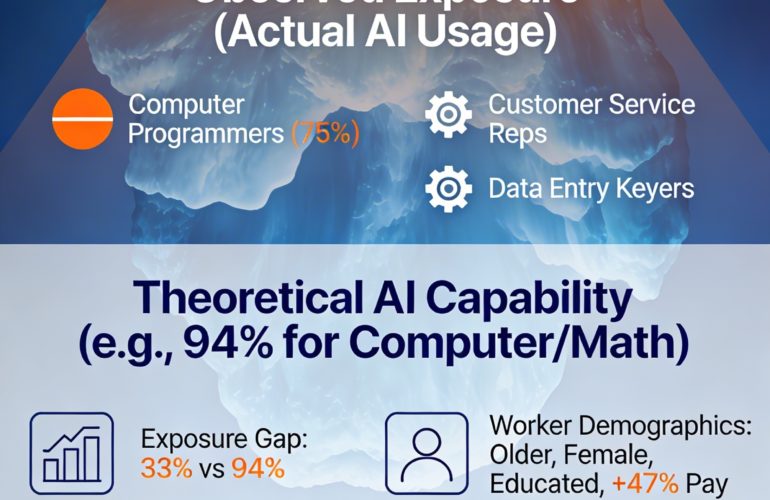
- Observed exposure combines theoretical AI capability with real-world usage data, revealing that actual AI coverage is only a fraction of what is theoretically possible (for example, AI covers just 33% of Computer and Math tasks despite being theoretically capable of 94%)
- Computer Programmers face the highest exposure at 75% coverage, followed by Customer Service Representatives and Data Entry Keyers, while jobs involving physical work or face-to-face interaction show minimal exposure
- Workers in highly exposed occupations tend to be older, female, more educated, and earn 47% more on average than those in unexposed roles, suggesting the impacts will be concentrated among specific worker groups
- No meaningful increase in unemployment has occurred for highly exposed workers since late 2022, though there is tentative evidence that hiring of young workers aged 22-25 into exposed occupations has slowed by approximately 14%
- The framework allows researchers to track AI impacts as they emerge rather than waiting for large disruptions to become visible, making it useful for identifying vulnerable jobs before displacement becomes widespread
Why It Matters
This research is significant for risk management because it provides an early warning system to identify which occupations and worker groups may face labour market disruption before widespread displacement occurs. The finding that younger workers are experiencing reduced hiring into AI-exposed roles suggests emerging labour market friction that could intensify as AI capabilities advance. The concentration of exposure among higher-paid, educated workers indicates that whilst some groups face disruption, others may be partially shielded. However, the gap between theoretical capability (what AI could theoretically do) and observed usage (what AI is actually doing) highlights substantial uncertainty: many tasks could theoretically be automated but have not yet been, creating both risk and opportunity depending on adoption speed. Risk managers should note that historical precedent suggests such labour market disruptions often play out over years rather than creating sudden shocks, making early intervention more feasible than crisis response. The framework’s ability to update regularly as new data emerges means early indicators of acceleration or deceleration in AI’s labour market impact should be monitored closely. The demographic skew towards female and highly educated workers in exposed roles may create specific policy and workforce planning challenges for organisations.
Read the full Anthropic’s study here.


