Early Warning Signs of Job Disruption

Quick Summary

Researchers at Anthropic have developed a new measure called observed exposure to track which jobs are actually being affected by AI in real-world settings, finding that whilst AI has significant potential to automate tasks, actual usage remains far below theoretical capability, and early evidence shows limited impact on unemployment but some signs of slowed hiring for younger workers.

Key Points

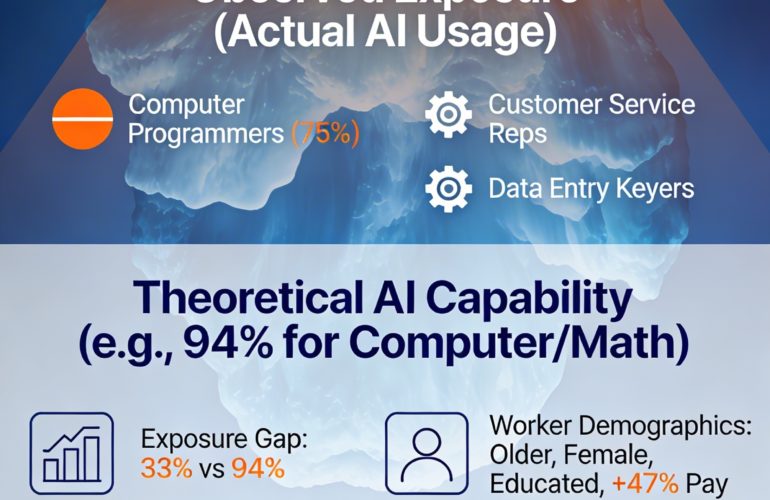
  • Observed exposure combines theoretical AI capability with real-world usage data, revealing that actual AI coverage is only a fraction of what is theoretically possible (for example, AI covers just 33% of Computer and Math tasks despite being theoretically capable of 94%)
  • Computer Programmers face the highest exposure at 75% coverage, followed by Customer Service Representatives and Data Entry Keyers, while jobs involving physical work or face-to-face interaction show minimal exposure
  • Workers in highly exposed occupations tend to be older, female, more educated, and earn 47% more on average than those in unexposed roles, suggesting the impacts will be concentrated among specific worker groups
  • No meaningful increase in unemployment has occurred for highly exposed workers since late 2022, though there is tentative evidence that hiring of young workers aged 22-25 into exposed occupations has slowed by approximately 14%
  • The framework allows researchers to track AI impacts as they emerge rather than waiting for large disruptions to become visible, making it useful for identifying vulnerable jobs before displacement becomes widespread

Why It Matters

This research is significant for risk management because it provides an early warning system to identify which occupations and worker groups may face labour market disruption before widespread displacement occurs. The finding that younger workers are experiencing reduced hiring into AI-exposed roles suggests emerging labour market friction that could intensify as AI capabilities advance. The concentration of exposure among higher-paid, educated workers indicates that whilst some groups face disruption, others may be partially shielded. However, the gap between theoretical capability (what AI could theoretically do) and observed usage (what AI is actually doing) highlights substantial uncertainty: many tasks could theoretically be automated but have not yet been, creating both risk and opportunity depending on adoption speed. Risk managers should note that historical precedent suggests such labour market disruptions often play out over years rather than creating sudden shocks, making early intervention more feasible than crisis response. The framework’s ability to update regularly as new data emerges means early indicators of acceleration or deceleration in AI’s labour market impact should be monitored closely. The demographic skew towards female and highly educated workers in exposed roles may create specific policy and workforce planning challenges for organisations.

Read the full Anthropic’s study here.

Read More

Going to Insurtech Insights 2024!

On our way to London to attend Insurtech Insights Europe 2024!

Looking forward to engage with top experts, explore cutting-edge tech and network with insurance professionals from around the globe. Let us know if you’re around!

The INGAGE Institute, AI Mentoring in Insurance –A-I-M-> empowers companies to lead the Future of Insurance by increasing competitivity with Innovation & Strategy Consulting, maximizing collaboration and performance with an AI-powered Underwriting & Claims Simulator and strengthening employer branding with Exclusive Interviews. 

#ITIEU24 #ITI #insurance #conference #london #europe #insurtechinsights#insurtech #ingageinstitute

Read More

Raising funds

For my fellow entrepreneur friends raising funds to scale up their companies, here is an inspiring talk from WeFox CEO, Julian Teicke. Have a nice Sunday 🙂

#inspiration #entrepreneurship #raisingcapital #raisingfunds #wefox #ceo #investors #investment #venturecapital #pitching #startup #startuplife

Read More

Scaling up!

Thanks to Ali Hauser, INGAGE CEO for Latin America, for this amazing business trip to London! After the ones in Zurich, it’s now the leading companies in London’s famous “City” that welcome our company’s products with a strong interest. Fantastic acceleration! We will need more talents to join us soon… 

Read More

Low code, no code

Whether you are a manager or a developer in InsurTech, you might have heard about “low code” and “no code”. In any case, here is an article that you might find interesting:

“Low code is a development movement where time-consuming manual processes are automated, without hand coding, using a visual IDE environment, an automation that connects to backends and some kind of application lifestyle management system. The whole unit is called a “low code platform”

Read on at https://www.bmc.com/blogs/low-code-vs-no-code/


Read More

How InsurTech is reshaping insurance

Opportunities await

Source: PwC

Insurance companies are very much aware of the FinTech revolution: 74% of respondents see FinTech innovations as a challenge for their industry. There is a good reason to believe that insurance is indeed heading down the path of disruptive innovation, whether it is the effect of an external factor, such as the rise of the sharing economy, or the ability to improve operations using artificial intelligence.

However, despite these emerging trends, a disconnect exists between the amount of disruption perceived and insurers’ willingness to invest to defend against and/or take advantage of the innovation: 43% of the industry players claim they have FinTech at the heart of their corporate strategies, but only 28% explore partnerships with FinTech companies and even less than 14% actively participate in ventures and/or incubator programs.

Incumbent insurers who are currently focused on catching up with their competitors around customer centricity and other current trends are missing the opportunity to become proactive. They need to create a clear and consistent message that will demonstrate their willingness to play in the new InsurTech space and act accordingly – only such an approach will position incumbents to be frontrunners in the new insurance era.

[ DOWNLOAD ]

Read More